
Fibers Fund and Invest Appalachia jointly back Renaissance Fiber with catalytic financing
Innovative loan and recoverable grant will support next phase of growth for North Carolina fiber hemp processor
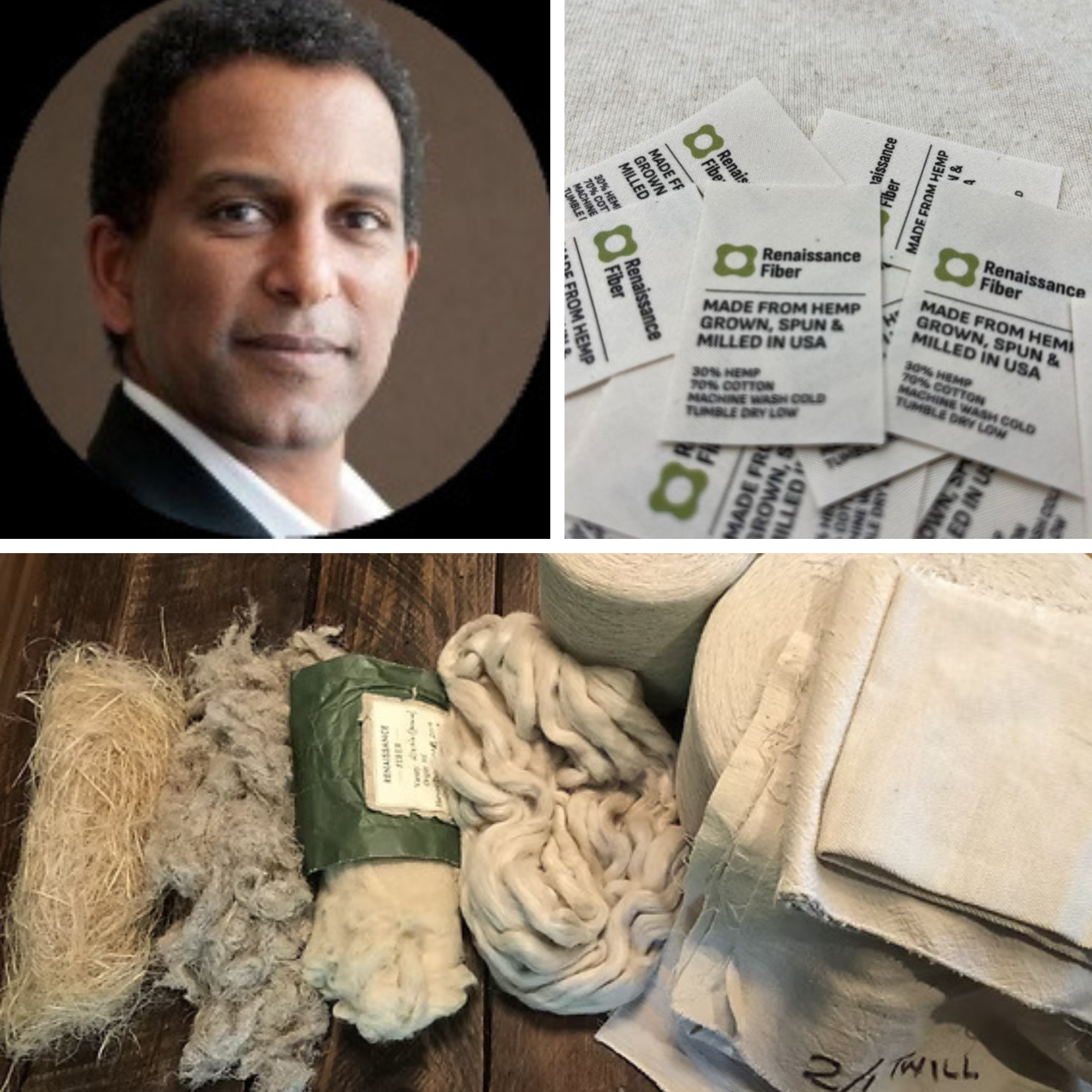
Photos courtesy Renaissance Fiber
The Fibers Fund and Invest Appalachia are proud to announce aligned, catalytic financing support for Renaissance Fiber, a North Carolina fiber hemp processing company. Using proprietary technology, Renaissance Fiber purchases raw, domestic hemp fiber and processes it into forms suitable for textile production on existing U.S. manufacturing equipment. Based in Winston-Salem and Mocksville, NC, Renaissance has built relationships with regional farmers, yarn spinners, textile mills, and companies that produce brand-name garments and products, positioning it as a critical node for the state and region to maintain leadership in fiber agriculture and textile production.
The combined financing support includes a low-interest, three-year loan from the Fibers Fund, alongside flexible and affordable recoverable grant financing from Invest Appalachia’s Catalytic Capital pool. Through this innovative partnership, Fibers Fund and Invest Appalachia will enable Renaissance Fiber to take the critical next step from its R&D phase to full operation of its initial fiber hemp processing line. Funds will support Renaissance in purchasing raw fiber from U.S. growers and completing all processing steps to meet the growing demand for their hemp yarns from regional mills and buyers. Together, this financing is already proving catalytic for Renaissance–since receiving initial commitments from Invest Appalachia and Fibers Fund, Renaissance has leveraged this evidence of support to qualify for a loan from the Small Business Administration 7(a) Manufacturers Access to Revolving Credit (MARC) program, generating over 8x leverage already. The financing package helps further the shared mission of Fibers Fund and Renaissance Fiber to promote soil-based fibers and textiles as an integral part of holistic regenerative agricultural systems, while also furthering Invest Appalachia’s mission to ensure that each community in Central Appalachia is equipped with the investment necessary to thrive now and in the years to come.
About Renaissance Fiber
Renaissance Fiber is a North Carolina clean-tech and ag-tech company that manufactures softened hemp fiber for the textile industry. Renaissance Fiber's technology is a two-step proprietary process to convert raw hemp fiber into textile fiber: first the fiber is degummed in a wet processing step, and then the fiber is milled or refined into textile fiber suitable for spinning into yarn.
Fiber hemp comes from the outer layer of the hemp plant’s stalk, and has played a large and important role in human history. Hemp fiber is agriculturally sustainable, strong and durable, breathable, and easily blended with other fibers, leading to growing demand from manufacturers of t-shirts, denim, travel apparel, and other categories, including military applications. However, fiber hemp has historically been limited to long-line wet spinning technology, similar to that used for flax to make linen. While this makes a beautiful, lustrous, strong yarn, long-line wet spinning for bast fibers is a small niche, under 1% of global yarn spinning capacity. Critically, Renaissance Fiber’s technology enables hemp fiber to be used to make the finest yarns with the highest hemp content, as a plug-and-play fiber within the cotton/polyester yarn-spinning infrastructure in most of the world, unlocking major growth potential in the U.S. supply network.
Renaissance’s “Ecologically InvisibleTM” degumming technology addresses several key issues for the U.S. fiber hemp industry:
Their degumming methods are clean and scalable, reducing water and energy use.
They are able to use a wide range of input material qualities, supporting new U.S. farmers to begin trialing and expanding hemp fiber production.
After the degumming step, the company’s fiber refining process can be done with standard textile machinery, eliminating the need to import specialized equipment.
Renaissance Fiber’s refining technology is enhanced and informed by a Cooperative Research and Development Agreement (CRADA) with the USDA for hemp fiber processing, which also grants it exclusive licensing rights to technology developed within the CRADA.
Currently, over 70% of global fiber production is made from petroleum-derived synthetics, positioning Renaissance’s work with soil-based fiber hemp as a key part of climate-beneficial regenerative agriculture solutions. In addition, Renaissance brings a demonstrated commitment to its North Carolina and Appalachian communities and its farmer suppliers through its revitalization of underutilized rural industrial space in Mocksville, NC, and support for the Piedmont Agricultural Innovation Collective (PAIC) co-op of fiber hemp growers in the region.
Led by CEO Daniel Yohannes, Renaissance Fiber, Inc. launched in 2022 and has dedicated several years to perfecting its technology and preparing to operate at scale as a processing partner for existing U.S. textile manufacturers in the Southeast and beyond. For more information, visit renaissance-fiber.com.
About Invest Appalachia
Invest Appalachia is a regional blended capital platform, designed to accelerate and expand community investment across Central Appalachia. With a mission to help finance Appalachia’s transition to a more resilient, equitable, and sustainable economic future, IA works across the Appalachian counties of Kentucky, West Virginia, Virginia, Ohio, North Carolina, and Tennessee. Through creative financing from the IA Fund and IA’s risk-absorbing "Catalytic Capital" pool, Invest Appalachia addresses capital gaps for projects that create community impact but do not qualify for traditional financing. IA is governed by a regionally representative board and focuses on diversifying local economies and building wealth among underserved populations. To learn more, visit www.investappalachia.org.
About The Fibers Fund
The Fibers Fund is a catalytic fund to support U.S. natural fiber and textile producers and processors, with a specific focus on economic justice. Fiber crops (such as flax, cotton, fiber hemp, wool, leather, and natural dyes) are an integral part of regenerative agricultural systems, yet the sector has received little attention from investors. Fiber entrepreneurs working to meet the growing demand for sustainable textiles struggle to access capital, and these barriers are especially pronounced for entrepreneurs from underserved communities.
Launched in 2023 to fill these capital gaps, the Fibers Fund offers flexible capital to U.S. natural fiber producers and processors in the form of patient term loans, forgivable loans, and business TA grants, combined with wraparound support. With its values-based governance structure and 100% women leadership, the Fibers Fund was selected as a 2023 Transformative 25 fund, a list of funds “transforming the economy for social, environmental, and economic justice,” and featured on Impact Alpha as an innovative debt fund. To date, the Fund has deployed ~$1M in patient loans and grants, over 60% to people of color-led fiber businesses and over 80% to women-led businesses. Learn more about the Fund’s work, team, and portfolio at fibersfund.com.
Catalytic financing bridges a key financing gap
The Fibers Fund loan and Invest Appalachia recoverable grant financing will help Renaissance Fiber bridge a key financing gap–the jump from the R&D phase to full production. In background interviews for the Fibers Fund, natural fiber and textile businesses across the U.S. described their difficulties in accessing capital for this specific stage–when textile buyers need greater scale of production to commit to purchases, but the company needs financing to reach scaled production. More broadly, many agricultural funds and programs do not include fiber producers, and other lender types are unfamiliar with this sector.
Together, the aligned Fibers Fund and Invest Appalachia financing is already helping Renaissance to break through this bottleneck–allowing them to purchase the raw U.S. fiber hemp needed to fully operate their processing line and produce hemp yarns that are already drawing the attention of regional fabric mills and brands. With the additional leverage of the new SBA MARC loan, this early financing is demonstrating how flexible, first-in capital can catalyze significant additional financing for creative place-based businesses in sectors that are traditionally overlooked.
Investing in the local community
According to Daniel Yohannes, CEO of Renaissance Fiber, “What excites me most is that we’re building a business that is rebuilding a domestic supply chain that the U.S. needs now more than ever. By working directly with our regional farmers and processing fiber right here in North Carolina, we’re keeping value in the community at every step of the chain. This financing from Invest Appalachia and the Fibers Fund allows us to do that at real scale for the first time, and that means real, lasting impact for the people of this region.” He went on to note that “The Fibers Fund loan and Invest Appalachia’s catalytic grant are exactly the kind of first-in, flexible capital a textile manufacturing company like ours needed to move from R&D to true production. Together, they give us the confidence to buy more hemp from American farmers and invest in inventory and farmer relationships. Their capital represents patient and early debt we needed to scale, and additionally had a multiplier effect in that it helped catalyze our ability to bring in an even larger SBA-backed bank loan.”
“The Fibers Fund is delighted to support Renaissance Fiber with this new loan,” added Sarah Kelley, Managing Director of the Fibers Fund. “Over the course of our work with them, we’ve been continually impressed by their determination and commitment to community. Renaissance was facing a textbook example of the Commitment Catch-22 we identified when launching the Fibers Fund: buyers seek scaled production before committing to contracts, but textile businesses can’t scale production without capital. Renaissance has the technology, the farmer relationships, and the market interest, and they needed first-in capital that understood their sector and region. We’re proud to provide the catalytic capital to bridge that gap, and we’re especially proud to partner with Invest Appalachia, whose collaborative spirit and exceptional team have made this a truly integrated capital deal.”
Andrew Crosson, CEO of Invest Appalachia, adds, "Renaissance Fiber is proving that the transition to a sustainable regional economy can be built on the strength of our own agricultural heritage. While traditional commercial finance often overlooks the economic potential of domestic textiles, we recognize North Carolina’s rich textile history and see a team with the technical pedigree to bridge a critical gap in the U.S. hemp supply chain. By pairing our Catalytic Capital with Fibers Fund’s lending, we have helped to unlock economic opportunity in a growing sector. We hope to see Renaissance Fiber’s sustainable innovation turn into a driver of job creation and long-term economic resilience, while ensuring that farmers in our region are the primary beneficiaries of the burgeoning industrial hemp industry.”
Implementing Partners
This Fibers Fund loan will be serviced through its trusted partnership with Broadstreet Impact, an impact financial services company that offers both fund management and fund administration services. The Fibers Fund also continues its valued partnership withImpact Charitable, which houses a special purpose fund that allows the Fibers Fund to take in and deploy philanthropic capital as a component of its integrated capital model. The Fund also maintains close ties with its founding partners, Sustainable Agriculture and Food Systems Funders and Fibershed.
Opportunities for Investors and Funders
Support for the Fibers Fund and the loan to Renaissance Fiber is provided by a network of funders and accredited investors, including philanthropies, donor-advised funds, family offices, and impact-focused investors. With ~$1M already deployed, over 60% to POC-led businesses and over 80% to women-led businesses, and an 8x leverage ratio demonstrated in the Renaissance Fiber financing alone, the Fund is actively seeking to complete its second close in 2026 to expand its portfolio of catalytic loans and TA grants to U.S. natural fiber businesses. The Fibers Fund welcomes inquiries from accredited investors and foundations interested in catalyzing impact for underserved fiber entrepreneurs across urban and rural areas.
Invest Appalachia’s Catalytic Capital program is supported by private philanthropic funding, including from national foundations, DAFs, family foundations, and corporate foundations. Catalytic Capital funders can direct their funds to a sector or impact area of choice, such as regenerative agriculture, sustainable manufacturing, community ownership, or climate adaptation. The Invest Appalachia Fund is closed to investors and focused on deployment, though a successor “IA Fund 2” will be open to impact investment in late 2026/early 2027.
Contact Us
For more information, contact the following:
Fibers Fund: Sarah Kelley, Managing Director, [email protected]
Invest Appalachia: Lauren Sowers, Communications Manager, [email protected]
Renaissance Fiber: Daniel Yohannes, CEO, [email protected]